How Gratitude Can Help You Heal Emotionally After Divorce and Start Again
How Gratitude Can Help You Heal Emotionally After Divorce and Start Again
How a Simple Daily Practice of Gratitude Can Help You Move Through the Emotional Lows of a Relationship Break-Up and Begin Again with Clarity
Divorce, separation, or the ending of any long-term relationship rarely arrives quietly.
Even when the decision was yours.
Even when it was needed.
Even when you know, logically, that leaving was the right thing to do.
There is still grief.
Grief for what was.
Grief for what is.
Grief for what could have been.
There is still a nervous system that has to recalibrate to a life that no longer looks the way it did.
There are still habits of thought that circle back to the past, replaying conversations, questioning decisions, wondering what you missed, or what you could have done differently.
Most of the women I work with are not falling apart on the outside.
They are still working.
Still parenting.
Still managing responsibilities.
Still showing up for everyone else.
On the outside, they look fine.
But internally, they are tired.
There is often a quiet emotional low that follows the practical process of divorce.
The paperwork might be signed.
The house might be sold.
The legal process might be complete.
Yet the mind is still living back there.
Still analysing.
Still looping.
Still holding onto resentment, regret, anger, sadness, or confusion.
And this is where many women get stuck.
Because no one really talks about the next step.
Not the logistics of divorce, but the emotional transition from who you were in that relationship to who you are becoming now.
This is where a practice like gratitude becomes less of a “nice idea” and more of a tool.
Not to bypass grief.
Not to pretend everything is fine.
But to help your brain and body stop living in the past, so you can start building something meaningful in the present.
This is also where your work begins to move through the stages of change.
It starts with awareness, which you can explore further here:
Awareness: Why You Feel Stuck
Why Your Mind Keeps Returning to the Past After Divorce
After a relationship ends, the brain does not simply move on because you have decided to.
The mind is wired to:
Look for threat
Avoid pain
Make sense of loss
Reconstruct events to regain control
Which means it will naturally:
Replay conversations
Revisit mistakes
Search for warning signs
Focus on what went wrong
From the brain’s perspective, this is protective.
“If I understand what happened, maybe I can prevent it next time.”
The problem is, this ongoing analysis keeps your nervous system in a state of alert.
You are no longer in the relationship, but emotionally and physiologically, part of you is still bracing for it.
Still defending yourself.
Still proving your worth.
Still trying to make sense of something that may never feel fully logical.
This is why so many women say:
“I just want to stop thinking about it.”
And why simply telling yourself to “move on” rarely works.
Because moving forward is not just a decision.
It is a process.
(And if you’ve ever felt stuck in that space between knowing and doing, this explains why:
Why Personal Change Is So Hard)
Gratitude Is Not About Being Thankful for What Happened
Let’s be clear.
You do not need to feel grateful for the divorce.
You do not need to feel grateful for the betrayal, the loss, the loneliness, or the upheaval.
Gratitude is not about approving of the past.
It is about redirecting your attention in the present.
When you practise gratitude deliberately, you are not pretending life is perfect.
You are training your brain to notice:
What is safe now
What is working now
What is possible now
Because after divorce, the brain becomes biased toward:
What is missing
What was lost
What could go wrong again
Gratitude helps to rebalance that.
The Science of Gratitude and Emotional Recovery
Research from the HeartMath Institute shows that when we genuinely feel gratitude or appreciation, something measurable happens in the body.
Our heart rhythms become more coherent.
This improves:
Mental clarity
Emotional resilience
Decision-making
Stress recovery
In simple terms, your body begins to move out of survival mode.
Gratitude interrupts rumination.
It gives your mind somewhere else to go.
Instead of looping on what is painful, it begins to register what is supportive.
This does not remove grief.
But it creates space around it.
What Happens in the Brain When You Practise Gratitude
Gratitude activates areas of the brain involved in:
Emotional regulation
Higher-order thinking
Motivation
Decision-making
It also supports systems that regulate:
Stress hormones
Sleep
Immune function
When practised consistently:
Dopamine increases, supporting forward movement
Serotonin improves mood stability
Cortisol decreases, reducing stress
Gratitude also activates the parasympathetic nervous system, helping your body feel safe again.
And after a relationship that kept you on edge, that matters more than most people realise.
Gratitude Helps You Shift Your Emotional Baseline
Many women believe they will feel better once life looks different.
Once things settle.
Once the future is clearer.
Once something new begins.
But your emotional baseline is shaped by:
What you focus on
How you interpret experiences
What you repeat
Gratitude shifts this.
It trains your brain to:
Notice more than just what is wrong
Recognise support and stability
Reduce fixation on threat
This is not forced positivity.
It is expanding your awareness.
And from awareness, desire can begin to return.
(If you’ve felt disconnected from what you want, this is the next step:
Desire: Relearning What You Want After Years of Disconnection)
The Four A’s of Gratitude
Gratitude is often broken into four simple elements:
Appreciation
Approval
Admiration
Attention
When you practise these consistently, something shifts.
You begin to:
Reconnect with your own worth
Strengthen your relationships
Feel more emotionally steady
After divorce, when identity can feel uncertain, this matters deeply.
Because you are not just rebuilding a life.
You are reconnecting with yourself.
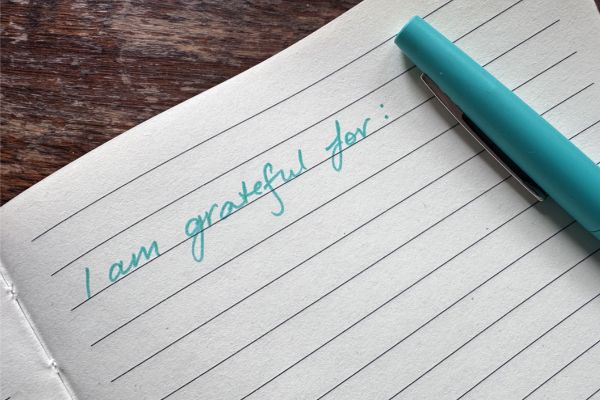
A Simple Gratitude Practice for Moving Forward
This is simple.
But it works when you do it consistently.
Each day, take five minutes to reflect on:
One thing you appreciate about yourself
One thing that went well today
One person or experience you are grateful for
Write them down.
Be specific.
Instead of:
“I’m grateful for my friend.”
Try:
“I’m grateful that she listened without trying to fix anything.”
Over time, this helps your brain:
Stop scanning only for loss
Register support
Notice stability
Recognise growth
You can also:
Write thank-you messages
Keep a journal
Reflect before sleep
Practise during meditation
These small, repeated choices matter.
And this is where change starts to build:
How Small Daily Choices Shape Your Life
Gratitude Builds Emotional Resilience
When gratitude becomes part of your daily life:
Emotional reactions become easier to manage
Stress responses soften
Challenges feel more manageable
It becomes easier to move forward.
To take action.
To rebuild.
This is where gratitude shifts from coping to creating.
Because healing is not just about getting through what happened.
It is about deciding what comes next.
And when you reach that point, this becomes important:
Decision: Why You Stay Stuck and How to Move Forward
Starting Again with Intention
Gratitude does not fix everything.
But it creates:
Mental clarity
Emotional steadiness
Physical calm
Which allows:
Better decisions
Clearer direction
Less fear around the future
Your future is created by what you do today.
And today might be simple.
Noticing:
The light coming through the window
The comfort of your space
A moment of quiet
The fact that you are still here
These small moments matter.
Because they remind your brain:
Life is not only what ended.
It is also what is beginning.
A Different Way to Look at Moving Forward
Starting again is not about becoming someone new overnight.
It is about gently shifting your attention.
Again and again.
Until what once felt heavy begins to loosen.
Until what once felt unclear begins to settle.
Until what once felt like survival begins to feel like choice.
And eventually, this becomes natural.
This is where it leads:
Mastery: When Change Becomes Who You Are
The Shift From Survival to Choice
Gratitude will not erase what you have been through.
But it will change how you carry it.
It helps you step out of the past.
It helps your body feel safer again.
It helps your mind look forward.
And from there, everything else becomes possible.
Remember: Your future is created by what you do today.