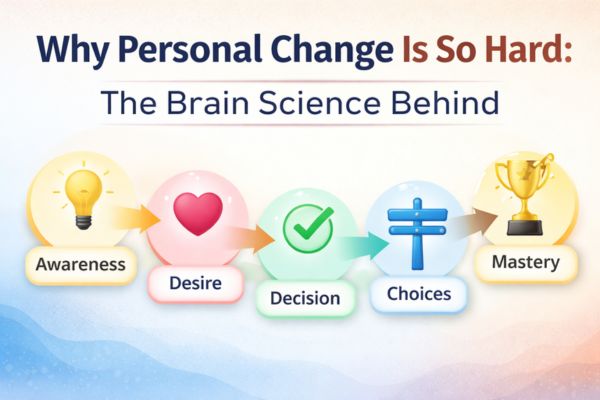
Why Personal Change Is So Hard (And How to Finally Break Old Patterns)
Why Personal Change Is So Hard
The Brain Science Behind
Awareness → Desire → Decision → Choices → Mastery
Have you ever noticed how hard it is to change, even when you know exactly what needs to change?
You can see it clearly.
You can feel it.
And yet, you still find yourself repeating the same patterns.
You might say things like:
"I know I shouldn't keep doing this."
"I know this relationship isn't good for me."
"I know I need to take better care of myself."
Yet somehow you still find yourself doing the same things.
The same habits.
The same patterns.
The same frustrations.
This is where many people start judging themselves.
They think they are weak.
They think they lack discipline.
They think something is wrong with them.
But the truth is much simpler.
Real change follows a process.
Your brain moves through a series of stages before behaviour truly shifts.
In my work I describe this process very simply:
Awareness → Desire → Decision → Choices → Mastery
Once you understand these five stages, something powerful happens.
Instead of feeling stuck, you begin to see exactly where you are in the process.
And that makes change far easier to create.
This is also the foundation of what I call The Reclaim and Rebuild Method.
It is the process I use to help women understand what has shaped them, reconnect with what they truly want, and begin creating change in a way that feels steady, real, and lasting.
Rather than trying to force change from the outside, we work from the inside out, through awareness, desire, decision, daily choices, and eventually mastery.
The Five Stages of Real Personal Change
Lasting change rarely happens overnight.
It unfolds in stages.
Awareness
Desire
Decision
Choices
Mastery
Each stage builds on the one before it.
Many people struggle because they try to skip stages.
For example, they try to force themselves into action before they have truly made a decision.
Or they become aware of a problem but never develop the desire to change it.
Understanding this process allows you to work with your brain rather than against it.
Let’s look at each stage more closely.
1. Awareness
The Moment You See Something Clearly
Every real change begins with awareness.
Awareness is the moment you see a pattern in your life.
You notice something about your behaviour, your thinking, or your relationships that you had not fully recognised before.
Psychology calls this self awareness.
It is your brain's ability to step back and observe yourself.
Without awareness, change simply cannot happen.
You cannot change something you cannot see.
Inside the brain, areas responsible for reflection and decision making become active when we become aware of our own behaviour.
This is what allows us to pause and ask deeper questions.
Example
A woman going through divorce suddenly recognises something that may have been obvious to everyone else.
What many women don’t realise is that this didn’t start in the relationship.
It built over time, across different stages of life, slowly shaping how they show up, what they tolerate, and what they believe is normal.
If you want to understand how this develops over time, read “Life After 50: Why So Many Women Feel Lost, and How to Reclaim Yourself”.
Throughout her marriage she avoided conflict.
She stayed quiet to keep the peace. She pushed down her feelings.
She told herself everything was fine and she believed that but that wasn't the truth, even though she thought it was.
Then one day she realises: "I have spent years putting everyone else's needs before my own."
That moment is awareness.
Nothing has changed yet. But the truth has become visible to her.
Once you see something clearly, you cannot unsee it.
Another Example
Someone begins to notice something about their spending habits.
Every time they feel stressed, overwhelmed, or upset, they end up buying something.
It might be online shopping late at night.
A quick trip to the shops to "treat themselves".
Or clicking purchase on something they didn’t even really need.
At first they believe the problem is money.
They tell themselves: "I need to be better with my budget."
But when they look a little deeper, they realise something important.
The spending isn’t really about money. It is about emotion.
Buying something gives them a short burst of relief. A moment of comfort.
A small distraction from how they are feeling.
That moment of recognition is awareness.
They realise they have been using spending as a way to manage stress.
And once they see that pattern clearly, they can begin to change it.
You can read more about awareness in the article:
Why You Keep Repeating the Same Relationship Patterns After Divorce
2. Desire
Wanting Something Different
Awareness on its own does not create change.
Many people become aware of their patterns but stay exactly where they are.
The next stage is desire.
Desire is the part of you that begins to want something different for your life.
It is the moment you start asking yourself questions like:
What do I really want?
What would make me happy?
What kind of life do I want to live?
Desire is about reconnecting with what matters to you.
What you enjoy.
What you love doing.
Who you want to be.
For many people this can feel strange at first, especially if they have spent years putting other people first.
They may not even know what they want anymore.
But slowly something begins to stir inside.
A quiet voice that says: "There has to be more than this."
That feeling is desire.
It is the emotional energy that begins pulling you toward a different future.
Your brain is designed to move towards things that feel meaningful or rewarding. When you start imagining a life that feels better, your brain becomes motivated to move in that direction.
In simple terms:
Awareness shows you what isn’t working.
Desire helps you imagine what could be possible.
Example
The woman who has always taken care of everyone else begins asking herself a new question.
"What would my life look like if I chose myself for once?"
She starts imagining things she never allowed herself to consider before.
Travelling.
Learning something new.
Building new friendships.
Living life on her own terms. Being happy and contented.
That feeling is desire.
Another Example
Someone who feels exhausted and burnt out begins imagining a different way of living.
They imagine waking up with energy.
Having time for themselves.
Feeling calm instead of constantly overwhelmed.
That vision creates desire.
Desire creates movement.
It gives your brain a direction to move towards.
You can read more about desire in the article:
Why You Feel Lost After Your Kids Leave
3. Decision (or intention)
The Moment You Choose
Desire still is not enough.
Many people want change.
They imagine a different life.
They think about what they would like to do.
They talk about how things could be different.
But wanting something and choosing it are two very different things.
A decision is the moment you stop sitting on the fence it is the moment you intend to do something.
It is when you stop saying:
"Maybe one day."
"I should probably do something."
"I’ll think about it."
A real decision or intention sounds very different.
It sounds like:
"I’m doing this."
It is the moment you choose the direction your life is going to take.
You draw a line in the sand and say:
"This is my future now."
When someone reaches this point, something shifts inside them.
They stop waiting.
They stop hoping things will magically change.
They stop looking for permission.
They decide.
And that decision changes how they see themselves.
Instead of feeling like life is happening to them, they begin taking responsibility for where they are going.
Inside the brain, something interesting also happens.
The areas responsible for decision making and planning become active. Once a decision is made, your brain begins organising your attention and behaviour around that direction and the intention is set.
Your focus changes.
You start noticing opportunities you did not see before.
You begin asking different questions.
Instead of asking:
"Why does this always happen to me?"
You start asking:
"What do I need to do next?"
Example:
A woman who has spent years feeling invisible in relationships finally decides something.
"I will no longer abandon myself to keep someone else happy."
That decision changes how she sees herself.
She moves from feeling powerless to feeling responsible for her own life.
Another Example
Someone who has struggled with confidence decides:
"I am no longer hiding."
That one decision leads to new behaviour.
Speaking up.
Trying new opportunities.
Doing things that once felt uncomfortable.
Decision creates commitment.
Without it, change rarely moves forward.
To read more about intentions, read the blog
or How to Make a Decision When You Feel Stuck in Life
or Rebuilding After Divorce: A Holistic Guide to Turning Intentions Into Reality
4. Choices
The Small Actions That Change Everything
Once a decision is made, change still does not happen instantly.
A decision sets the direction.
But it is the choices you make every day that move you along the path.
Real transformation happens through small choices repeated over time.
After someone makes a true decision about their future, something interesting begins to happen.
Their choices start changing naturally.
Not because someone forces them to change.
But because the direction is now clear.
When you know where you are going, your daily choices begin to align with that destination.
You start asking yourself different questions.
Instead of asking:
“What do I feel like doing today?”
You begin asking:
“Does this choice move me closer to the life I’ve decided to create?”
Those small moments are where change really happens.
Each choice may seem small on its own, but together they shape the future.
Inside the brain, this process is known as neuroplasticity.
This simply means the brain rewires itself based on what you repeatedly do.
Every time you repeat a behaviour, a pathway in the brain becomes stronger.
The more often you make the same type of choice, the easier that behaviour becomes.
Over time it begins to feel natural.
What once felt difficult or uncomfortable slowly becomes normal.
Example
A woman decides she will begin setting healthy boundaries.
The decision is powerful.
But the real transformation happens through small choices such as:
Saying no when something feels wrong.
Speaking honestly about her needs.
Not over explaining herself.
Each time she does this, the new behaviour becomes stronger.
Another Example
Someone decides to improve their health.
The transformation does not happen through one big effort.
It happens through daily choices.
Going for a walk.
Eating differently.
Getting proper sleep.
Small choices repeated over time create real change.
Consistency matters far more than perfection.
To read more about choices read the blog How Small Daily Choices Shape Your Life (And How to Change Them)
5. Mastery
When Change Becomes Natural
The final stage is mastery.
Mastery is the point where the change you once had to work at becomes part of who you are.
You are no longer forcing yourself.
You are no longer reminding yourself what you should do.
You simply live differently.
The new behaviour feels normal.
This happens because your brain has fully integrated the new patterns.
Through repeated choices, the pathways in your brain have strengthened. What once felt unfamiliar or uncomfortable now feels natural.
At the beginning of any change, things often feel awkward.
You have to think about what you are doing.
You have to remind yourself to make different choices.
Sometimes it feels easier to fall back into old habits.
But over time something shifts.
The new way of living becomes your default.
Example
Someone who once struggled to say no now does it calmly and confidently.
They no longer feel guilty.
They no longer rehearse the conversation in their head.
It simply feels normal.
To read more about saying no, and gaining mastery read the blog Life After Divorce: Reclaiming Your Power and Embracing the Freedom to Say No
Another Example
A woman who once felt completely lost after divorce builds a life that feels aligned with who she truly is.
New friendships.
New confidence.
New opportunities.
Not because life suddenly became easy.
But because she moved through the full process of change.
Awareness → Desire → Decision → Choices → Mastery.
To read more about mastery, read the blog Mastery Is Integration, How Real Change Becomes Natural
Why Many People Stay Stuck
The reason many people struggle with change is because they stop somewhere in the process.
Some people stay at awareness.
They understand their patterns but feel powerless to shift them.
Others develop desire but never make a clear decision.
Some make decisions but fail to follow through with consistent choices.
Real transformation requires all five stages.
Each step supports the next.
To read more about why women stay so long read the blog Why Women Stay and How They Heal
Understanding the Process Changes Everything
Once you understand how change actually works, you stop expecting instant transformation.
You become more patient with yourself.
You realise growth is not one moment.
It is a series of steps.
And every step matters.
Even a single moment of awareness can begin the process.
How This Fits Into The Reclaim and Rebuild Method
In my work, change is not about becoming someone else.
It is about reclaiming the parts of yourself you had to disconnect from.
And rebuilding your life from a place that feels more honest and aligned.
If you would like to explore the full framework and how each stage works together, you can read the complete Reclaim & Rebuild Method here.
Awareness helps you see the pattern.
Desire reconnects you with what you want.
Decision gives you direction.
Choices create real change.
Mastery is where it becomes who you are.
This is how women begin to reclaim themselves and rebuild from the inside out.
Where are you on your journey?
Take a moment to think about your own life.
Ask yourself:
Where am I in this process?
Am I becoming aware of something?
Am I starting to desire or want something for my life that is different?
Have I made a clear decision to change yet?
What choices am I making every day? or What choices do I have now?
What might mastery look like in my life?
The answers to these questions can reveal the next step in your journey.
The Real Secret Behind Change
Many people believe change comes from motivation.
But motivation comes and goes.
Real transformation happens when your awareness, your desires, your decisions and your daily choices all begin working together.
Your brain then does something remarkable.
It rewires itself around the life you are creating.
Small steps repeated over time reshape your habits, your thinking and your identity.
Change is not about perfection. It is about moving through the process.
Awareness → Desire → Decision → Choices → Mastery
One step at a time.
If you’re not sure where to start, go back to the beginning and read this again.
Then ask yourself one simple question: Where am I in this process right now?
Because the step you’re in will always tell you what to do next.
Remember: your future is created by what you do today.